Rome
September 22-25, 2003
Walking Through Two Millennia
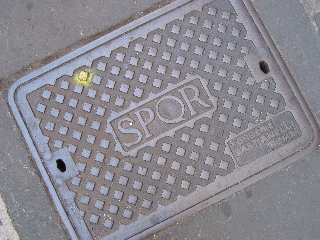 “SPQR”, Senatus
Populusque Romanus, was the common signature on monuments in Rome 2000 years
ago, and it’s used again on signs and manhole covers. This is just one of the
signs of continuity that surprised me in Rome. I knew that the city is over
2000 years old (2755, to be precise) and has remains from many centuries. What
I wasn’t quite prepared for was the mix of all of it. For example, I stand
in front of the main train station, a decidedly 20th century building, turn
around, and there are the ruins of Diocletian’s Baths from the 4th century,
part of which Michelangelo reused for a basilica in the 16th century.
“SPQR”, Senatus
Populusque Romanus, was the common signature on monuments in Rome 2000 years
ago, and it’s used again on signs and manhole covers. This is just one of the
signs of continuity that surprised me in Rome. I knew that the city is over
2000 years old (2755, to be precise) and has remains from many centuries. What
I wasn’t quite prepared for was the mix of all of it. For example, I stand
in front of the main train station, a decidedly 20th century building, turn
around, and there are the ruins of Diocletian’s Baths from the 4th century,
part of which Michelangelo reused for a basilica in the 16th century.
Here’s another corner where it all comes together: At the Piazza Venezia is
the Vittoriano, where Italy celebrates that it finally became a nation in 1861
(nine years before Germany). The
huge thing, nicknamed “typewriter” or “wedding cake”, comes with a monument
to Vittorio Emmanuele II, the first king, as well as the tomb of the unknown
soldier, of which apparently every self-respecting nation needs one.
The
huge thing, nicknamed “typewriter” or “wedding cake”, comes with a monument
to Vittorio Emmanuele II, the first king, as well as the tomb of the unknown
soldier, of which apparently every self-respecting nation needs one.
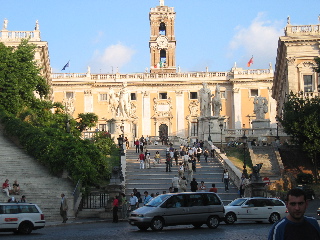 Right around
the corner is the Campidoglio, the hill that held the center of government
of the ancient Rome, but in its present form was designed by Michelangelo.
The few steps up to the Piazza actually stretch out far longer than you think
– it’s a long ramp with a nice little optical trick.
Right around
the corner is the Campidoglio, the hill that held the center of government
of the ancient Rome, but in its present form was designed by Michelangelo.
The few steps up to the Piazza actually stretch out far longer than you think
– it’s a long ramp with a nice little optical trick.
And behind the Campidoglio stretches the Roman Forum, the large field of ruins
of temples, monuments, government buildings, and market halls of the ancient
Rome, ending at the Colosseum. 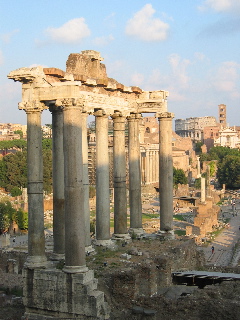
Places to Gather
 I’m not sure
whether it’s the Romans or the tourists, but Rome has numerous places where
people gather. Often they come with outdoor restaurants or cafes, other times
with markets, and sometimes with nothing more than other people to watch (as
here on the Spanish Steps). Gathering seems a common human need. I wonder when
San Francisco will catch on to this idea...
I’m not sure
whether it’s the Romans or the tourists, but Rome has numerous places where
people gather. Often they come with outdoor restaurants or cafes, other times
with markets, and sometimes with nothing more than other people to watch (as
here on the Spanish Steps). Gathering seems a common human need. I wonder when
San Francisco will catch on to this idea...
Small Country, Big Museum
In the midst of Rome is the only country in the world run as an absolutist
theocracy: The Vatican. It’s the smallest country, and like many small countries
has a side line in selling its own stamps. 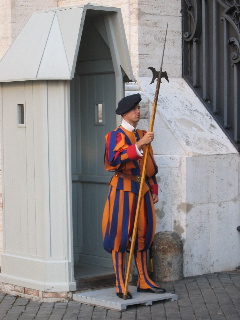 It
also has its own little military, the Swiss Guard. But its most visible assets
can be visited without border controls: The Vatican Museums and St. Peter.
Both are huge.
It
also has its own little military, the Swiss Guard. But its most visible assets
can be visited without border controls: The Vatican Museums and St. Peter.
Both are huge.
The Vatican Museums are so huge, that a visitor has to choose: One can carefully look at individual objects and spend a week in there, or cruise through it and stop only occasionally, and get through in a few hours. Conny once did the first, I opted for the second. In fact, I took shortcuts to get to the Sistine Chapel first, and then turned back to see some of the other parts.
The Sistine Chapel is impressive to see. There are hundreds of people, twisting their heads into dangerous positions in order to see paintings that have been tucked away on a high ceiling and could probably be better seen in the many books available for sale in the surrounding hallways. OK, some smart people had brought binoculars and so probably had a better view (but still a pain in the neck). And OK too, it is impressive to be surrounded by paintings, and some of the 3D-effects are quite good. The most amazing thing is that all this was done by a single person working by himself for four years. When do we ever spend four years on one project?
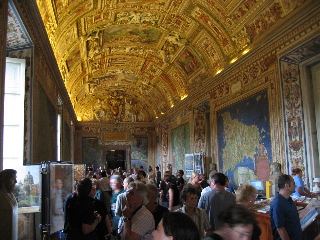 I find other
parts of the museums more interesting. The Egyptian collection has some fascinating
statues and cuneiform tablets. The Octagonal Courtyard feels so inviting, that
I would have liked to pull up a chair, order a mocha, and start reading a book.
Unfortunately, neither chair nor mocha were on offer. The map gallery was stunning,
and some details on the maps quite amusing – for example, the “iacta alea est”
comment on the Rubicon. And Raphael’s fresco on philosophy is very nice.
I find other
parts of the museums more interesting. The Egyptian collection has some fascinating
statues and cuneiform tablets. The Octagonal Courtyard feels so inviting, that
I would have liked to pull up a chair, order a mocha, and start reading a book.
Unfortunately, neither chair nor mocha were on offer. The map gallery was stunning,
and some details on the maps quite amusing – for example, the “iacta alea est”
comment on the Rubicon. And Raphael’s fresco on philosophy is very nice.
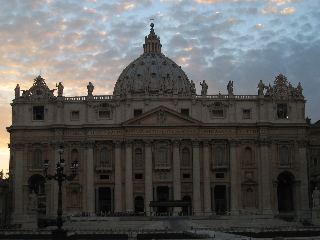 After the museums,
St. Peter. The square is humongous. The colonnades surrounding it are humongous.
Somehow the basilica itself doesn’t seem all that big anymore once I get in
– maybe that’s because it’s mostly empty. Rows and rows of benches would make
the dimensions more obvious, but they don’t exist. Later, when I see the space
from the dome above, it becomes clearer – the people walking around on the
floor are just little ants. Once on top, I also get marvelous views of the
entire city.
After the museums,
St. Peter. The square is humongous. The colonnades surrounding it are humongous.
Somehow the basilica itself doesn’t seem all that big anymore once I get in
– maybe that’s because it’s mostly empty. Rows and rows of benches would make
the dimensions more obvious, but they don’t exist. Later, when I see the space
from the dome above, it becomes clearer – the people walking around on the
floor are just little ants. Once on top, I also get marvelous views of the
entire city.
The Vatican is the 28th country I visit. Still about 180 to go...
Eating Italian
Eating in Italy turned out to be surprisingly frustrating. The food is usually good or better, no doubt. But Italians break up their meals into many separate courses – appetizer, soup or salad, pasta, meat and side dishes, cheese, fruit, sweets. In restaurants, each course shows up separately on the menu, and at least the pasta and meat portions each take on dimensions that are meals by themselves. If you order one of them and an appetizer or a side dish (often the only way to get vegetables), it’s likely already too much. Eating both pasta and a meat dish is a serious health risk. Evidently the system can easily be made to work if a group of people eats together and shares – but I’m traveling alone. Apart from the portion sizes, I’m also not quite convinced that separating all the dishes is such a great idea – especially Japanese cuisine has taught me the pleasures of having a variety of dishes on the table at the same time and nibbling here and there.